Guest post By Matthew Ilseman
It is not a surprise that Robert E. Howard, being from Texas, wrote Westerns. Of all the states in the union, Texas is the one most identified with the Wild West. Texans also identify with the Wild West. Perhaps more than they should…
While Howard was (along with Tolkien) one of the pillars of modern fantasy, wrote Middle Eastern adventure stories, historical adventure stories, horror and weird fiction, and comical boxing stories, he had a love of the history of Texas and the Southwest. It seems probable that before his tragic suicide he was planning to switch to the Western genre. One wonders what he would have achieved if he lived. One can gain some idea what that may have been like from Western Tales by the Robert E. Howard Foundation Press.
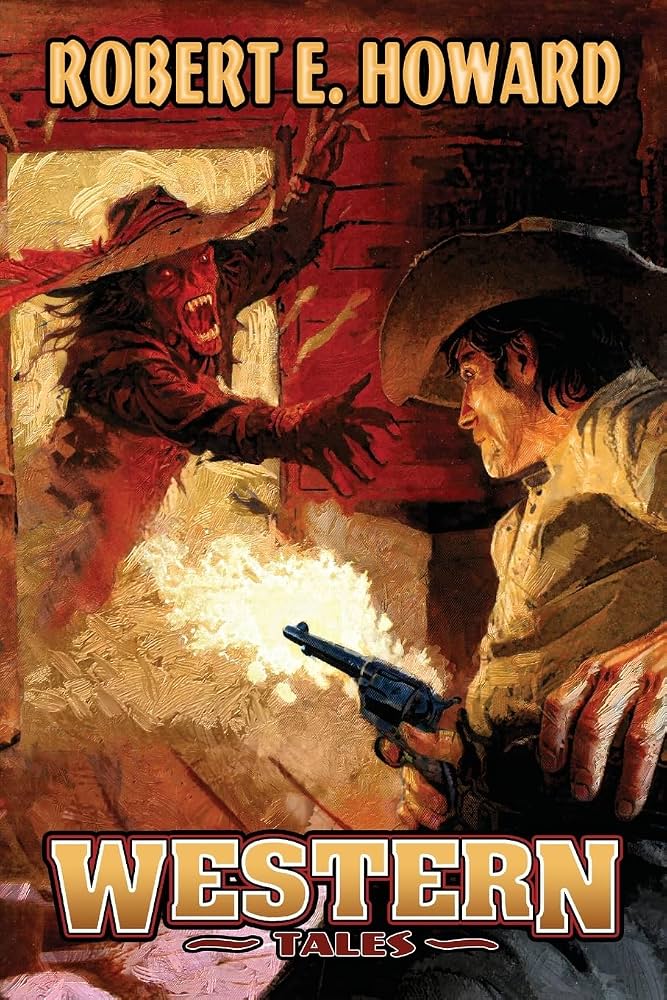
It collects all his serious Westerns. It does not have his comedic ones like his Breckinridge Elkins series. That is in different volumes. The book contains both his weird westerns and his non-supernatural ones.
Howard’s most famous and best Western tale is probably The Vultures of Wahpeton. The story is a precursor to the Spaghetti Western in that features not an upright hero, but a shady gunfighter out for his own gain. The main character is Steve Corcoran a gunfighter hired by the sheriff of Wahpeton to be his deputy. Originally, the sheriff wanted another man, but Corcoran ended up killing him in a gunfight. After getting the job Corcoran learns that the town is besieged by a secretive gang called the Vultures. No one knows who is a member of the gang. It turns out that the leader is none other than the sheriff who then convinces Corcoran to help defraud the other gang members. One of the interesting things is about Corcoran is his code. Howard states that he would not steal from an honest man, but has no problem doing it from another thief. He also makes clear that Corcoran would not harm a woman under any circumstances what so ever.
The story has two endings: the original one and one written because the editor of Smashing Novels (were it was published) wanted a happier ending. The original is tragic and bleak — and, frankly, the better ending.
Another highlight is Wild Water, which is one of the earliest examples of the Neo-Western. That is a story set in contemporary West. Contemporary to when it was written in this case. It begins with the protagonist Jim Reynolds shooting a corrupt business man to avenge outrages to a relative. After this he flees but a flood and a man with dynamite complicate things. The flood was a real one. (James Reasoner who wrote the detailed introduction to the book notes his father lived through it.) Wild Water is one of Howard’s more memorable tales.
Among the non-supernatural Westerns, there are also quite a few short stories and poems. These tend to pot boilers. A potboiler by Howard is better than a potboiler by many another writer. Sometimes they are better than “serious literature,” too. They are entertaining, but not as memorable.
His Weird Westerns, on the other hand, are. These include The Horror in the Mound which is a vampire story in Texas. There is also Old Garfield’s Heart a tale of a mysteriously long-lived man. That story references many parts of pre-Civil War Texas history notably Texas Ranger Jack Hays, and conflict with the Comanche.
Also of note are The Man on the Ground and Valley of the Lost, which involves supernatural horror and range feuds. (The latter is also a theme in many of Howard’s straight Westerns). There is also The Thunder Rider, in which a contemporary man of Comanche heritage remembers a past life. This story is similar to Howard’s Jim Allison Sword and Sorcery stories, but instead of the Celtic-type protagonist the hero is Comanche.
If you are a fan of Howard and Westerns you probably should get the book. It shows Howard’s love of history, but also how he pushed the edges of the Western genre. It would not be long after him that more morally ambiguous Westerns would appear. He was also among the first (if not actually the first) to incorporate supernatural elements into the genre. Other writers like fellow Texan Joe Lansdale would follow his lead.
Howard admired the pioneers of the Texas plains and in his own writing was a pioneer himself.
Matthew Ilseman is a writer whose fiction has appeared Swords and Sorcery Magazine, Schlock!, and Swords and Heroes Magazine.
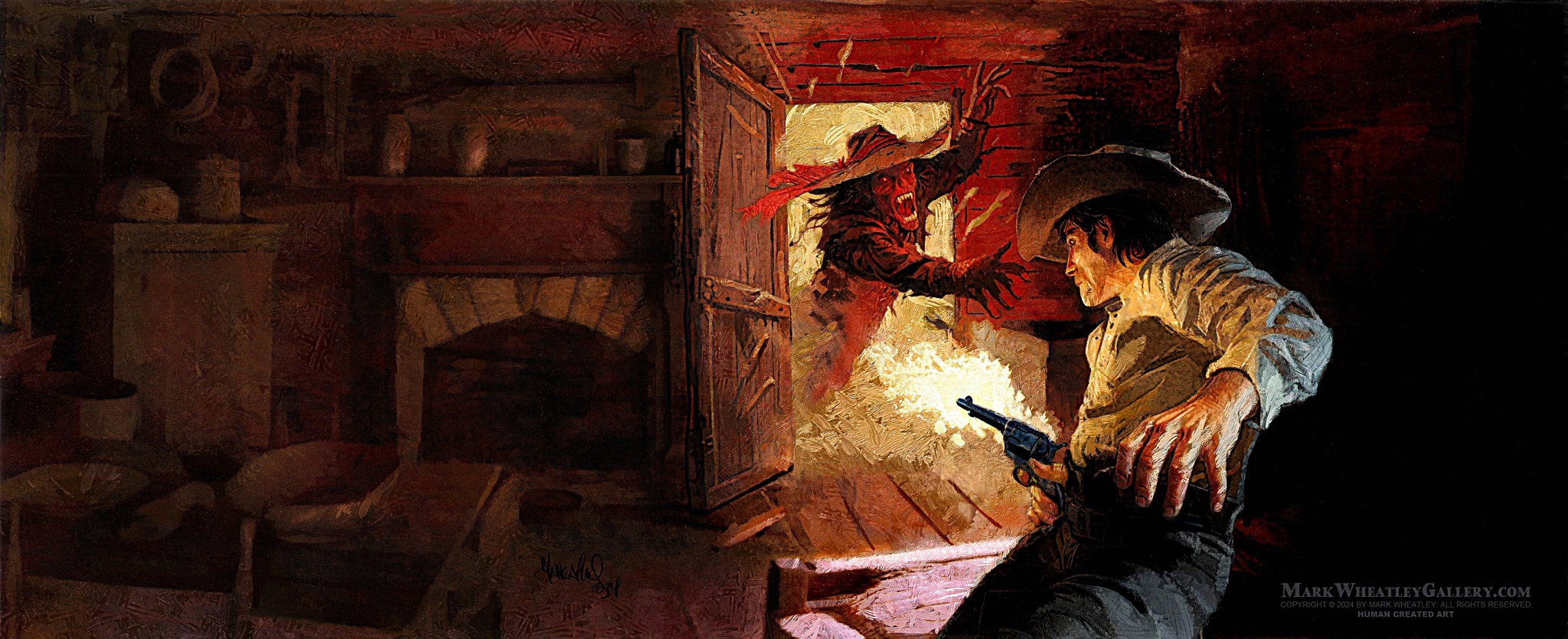
Frontier Partisans digs Mark Wheatley’s cover for this volume so much that we had to post the wrap-around. Badass.

Matthew Ilseman says
Yes, I forgot to mention the cover is awesome!
Quixotic Mainer says
I’m sold! I’ve read the Elkins story, and I believe Mound a long time ago but I would better appreciate it now.
I’m anxiously awaiting the final Dark Tower tale this fall, and wierd westerns that aren’t drivel are very hard to come by. Red Rabbit was the last one I tried that was halfway to good.
I absolutely concur on that cover art!
Matthew Ilseman says
I think you would like it.