The final trailer for Lioness Season 3 has dropped and, by Crom!, it looks like a billion bucks. This may actually fill the Strike Back-shaped hole in my heart. Season 2 really upped the game, and this one looks like it has solid production values, and has ratcheted up the stakes. Premiers August 2.

*
Missed this on publication in June — but Jack Carr saved the day by making it his July book club selection. Many Frontier Partisans readers remember Louis L’Amour’s Cold War thriller Last of the Breed as his best work. We get another one, thanks to a posthumous collaboration with his son Beau, who brought a draft story to publication. Looks like fun…
1961. The world is on the brink of nuclear war. Empires are crumbling. And in Barcelona, chaos is unleashed when a rogue officer of the East German Stasi attempts to blackmail a pair of struggling arms dealers. The secret—thirty tons of stolen gold hidden in an icebound wilderness at the end of the world.
Mike Fowler is a former Navy salvage diver and OSS assassin. Anton Voss is an expatriate German scientist whose past grows darker the closer anyone looks. Once they might have been enemies, yet the two share an inseparable bond: They have saved each other’s lives. But all of that is put at risk when Mike discovers Anton standing over a midnight visitor with a gun in his hand.
Now they’re on the run, allied with gangsters, pursued by the CIA, Israeli intelligence, and a shadowy cabal bent on creating an invisible empire. The trail leads from the rain-soaked docks of Marseilles to the futuristic towers of Caracas and the ruins of a secret island laboratory in Argentine Patagonia. The only way for Mike Fowler to save his oldest friends, and the woman he loves, is to unlock a decades-old mystery buried in his partner’s Nazi past . . . before it destroys them all.
Includes a special postscript by Beau L’Amour detailing the history of the original unpublished manuscript and the process of collaborating with his father both before and after his passing.
I read everything that Annie Jacobsen writes. It started with a friend passing me her book on Area 51, and continued with Surpise, Kill, Vanish, which explored the most covert aspects of American Special Operations, built around tales of that legendary outrider of empire, Billy Waugh.

She’s a Pulitzer Prize finalist, and a first-rate journalist with a deep roster of sources from within the apparatus of the American defense infrastructure and the military-industrial-technological complex.
Her latest book is a grim little bedtime story — Biological War: A Scenario:
A lab accident, a bio-attack, a global pandemic, and the collapse of human society. In this essential new book, based on dozens of new interviews with experts with high-level political, governmental, medical, and military responsibility, Annie Jacobsen examines this very scenario. It would be only a matter of days from such a global infection before the infrastructure built to handle this gravest of situations would be in a battle for human existence.
The fallout: mass death, total societal breakdown, widespread insurrection, anarchy, and a plague-ravaged wasteland that no longer resembles modern civilization. In other words: dystopia.
This stuff is chilling — truly horrible to contemplate. To me it is somehow worse than the nuclear threat. And it makes the pulpy goodness of Jonathan Maberry’s Joe Ledger yarns seem all too plausible.

Bouquet to Amherst, 23 June 1763
… Captain Ecuyer writes me that Fort Pitt is in good state of defence against all attempts from Savages, who are daily firing upon the Fort; unluckily the Small Pox has broke out in the garrison, for which he has built an Hospital under the Draw Bridge to prevent the Spreading of that distemper…
Amherst Memorandum [enclosured in letter to Bouquet, 7 July 1763]
Could it not be contrived to Send the Small Pox among those Disaffected Tribes of Indians? We must, on this occasion, Use Every Strategem in our power to Reduce them.
Bouquet to Amherst, 13 July 1763
… P.S. I will try to inoculate the [Indians] with Some Blankets that may fall in their Hands, and take Care not to get the disease myself.
As it is pity to expose good men against them I wish we would make use of the Spanish Method to hunt them with English Dogs, supported by Rangers and Some Light Horse, who I think effectualy extirpate or remove that Vermin.
Amherst Memorandum [enclosed as a postscript in letter to Bouquet, 16 July 1763]
You will Do well to try to Innoculate the Indians, by means of Blankets, as well as to Try Every other Method, that can Serve to Extirpate this Execrable Race. – I should be very glad [if] your Scheme for Hunting them down by Dogs could take Effect; but England is at too great a Distance to think that at present.
The historical record is not clear whether this plot was enacted, though Ecuyer wrote in June (prior to the Amherst/Bouquet exchange) that:
“We gave them two blankets and a handkerchief out of the smallpox hospital.”
There were reports of smallpox among the Ohio tribes, but it was a small outbreak and may have been endemic. Regardless, the intent was there, and it demonstrates that a sense of desperation can lead to unthinkably evil acts.
While it was certainly not a deliberate act, the spread of smallpox into the Blackfeet Nation in 1837-38 broke the military power of that mighty people, killing 6,000 people — approximately two-thirds of their population.
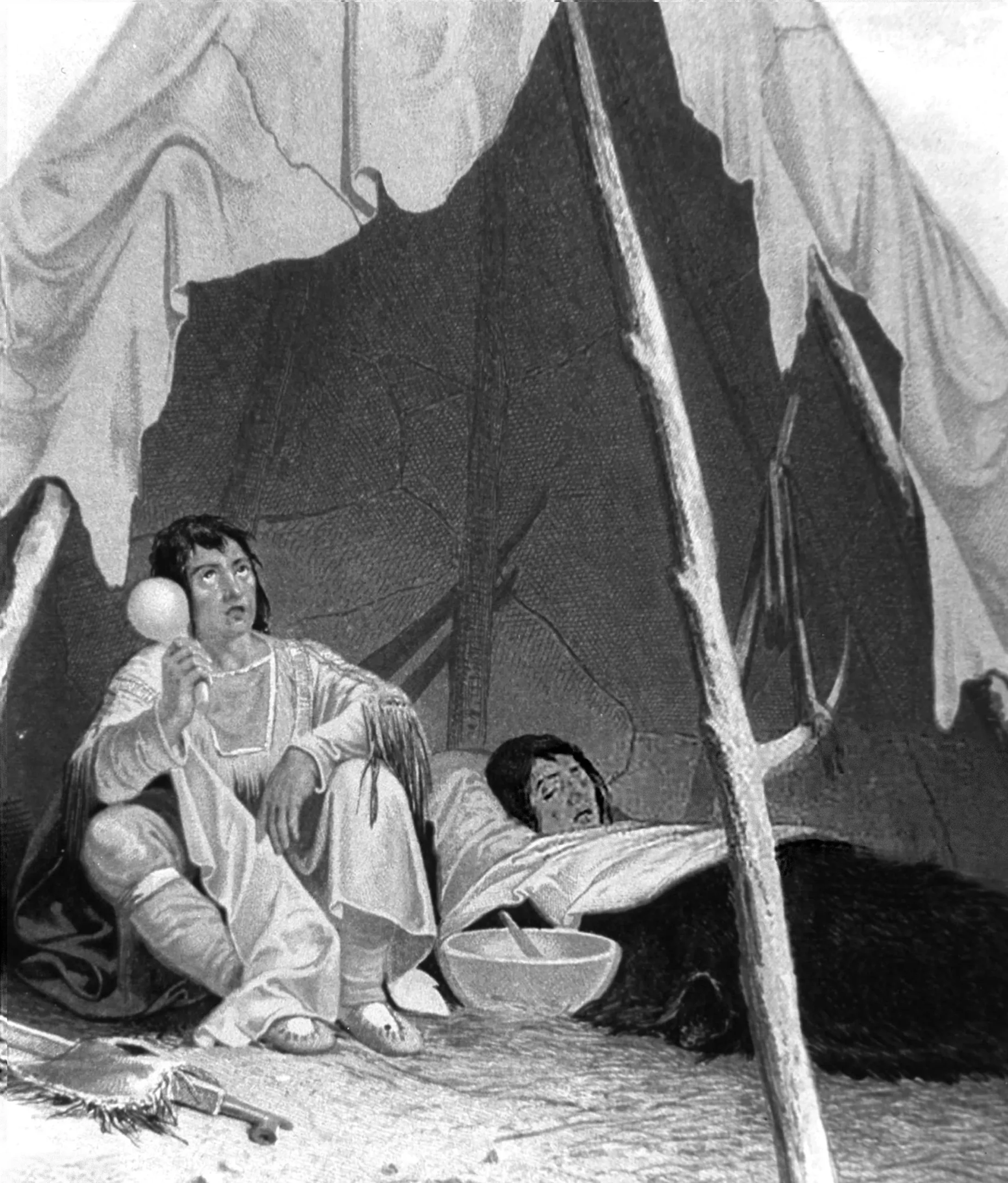
They were only one tribe devastated by the outbreak, which hastened the decline of the native peoples of the northern Great Plains. The Mandan, who lived in sedentary farming villages along the Missouri River, were almost completely destroyed.
One of the key aspects of Jacobsen’s book — one that is borne out in depictions of the Great Plains outbreak of 1837-38 — is that a major, deadly biological outbreak has almost immediately triggers societal breakdown. John Koster reports:
Even those Mandans not infected by smallpox sometimes killed themselves out of fear, despair or grief. Two infected warriors reportedly debated the best way to die; one cut his own throat, and the other forced an arrow through his lungs. A widow killed her two children and then hanged herself. One man shot first his wife and children, then shot himself with a trade musket by pulling the trigger with his toe. Others jumped off cliffs or drowned themselves when they developed the dreaded symptoms of smallpox.
According to Jacobsen, the Pentagon forecasts six days from outbreak to insurrection and anarchy.
Mind your top-knot and keep your powder dry…

John M. says
“Experts” always predict that disasters of various sorts will lead to panic/insurrection/anarchy. But the historical record consistently shows that ordinary Americans pull together and overcome in disasters. Whether our elites can manage to do the same is an open question nowadays.
Gregory A Walker says
An interesting sidenote –
“According to Professor Pearson, the Indian Vaccination Act was executed with systematic discrimination leaving many tribes without vaccination, tribes that were deemed as problematic with the United States government because they opposed settlers on their lands or were not willing to relocate. Professor Pearson details the history of ensuing smallpox epidemics that decimated those unprotected tribes later in the 1830s while those who were vaccinated resisted the epidemics. By the time the forced removal of Native Americans from their lands through acts like those resulting in the Trail of Tears, smallpox had helped the process of forced removal by leaving an innumerable number of Native Americans dead or disabled.”
https://historyofvaccines.org/blog/in-the-1830s-native-americans-learned-that-vaccines-could-be-used-as-both-weapons-and-rewards/
David Wrolson says
I ordered “Skyring Water” a couple of weeks ago and yes I loved “Last of the Breed.”
I always remember the chilling line from a package he sent to his surviving enemy in Russia-“In my lifetime I will take 2 scalps, this is the first.”
JimC says
Wonderful stuff.
Quixotic Mainer says
I love that Beau is plumbing the depths of his father’s unfinished tales, much in the same way Christopher Tolkien did. Some people might see it as exploitative, but I think in those cases it’s more like picking up a fallen banner and carrying it up over the next ridge.
There was one story in his Lost Tales where a young adventurer takes up working at an abandoned stage relay station that’s being menaced by an unnamed mystery creature. I wanted an ending so badly to that one I thought of writing it myself, but I’ve always shied away from fan fiction.
JimC says
Yep. That’s the way I see it.