Our friend Joe Engesser from Rock Island Auction Co. has served up an in-depth post that will please the palate of the firearms nerds who lurk around this here campfire. Those of us who actually ponder how and why the bolt action rifle prevailed as the standard military arm by the end of the 19th Century…

The bolt action and lever action rifle competed head-to-head in the 19th century as the world gradually embraced the self-contained metallic cartridge and the magazine-fed repeater. We’ll explore the bolt action vs. lever action faceoff through the decades.
*

My post-range gun-cleaning session was a good opportunity to take in this recently-posted doco on the strategic manhunt for Che Guevara in the backcountry of Bolivia. The key figure in this manhunt was Felix Rodriguez, a Cuban-born CIA contractor who had served as a paramilitary officer and participated in the failed Bay of Pigs caper to overthrow Fidel Castro in Cuba.
Rodriguez (with the captured Guevara, above) hated communists and was a highly motivated warrior in a decades-long shadow war. He did an excellent job of closing a net around Guevara — but the Argentina-born revolutionary wasn’t quite the holy terror the CIA and everybody else thought he was. He had a handful of followers who were starving and fighting with each other, and the area Guevara had chosen for guerrilla operations was not conducive, since the campesinos didn’t want what he was selling.

Success in Cuba and an iconic image and persona led people then and now to overrate Che’s talent as a guerrilla leader. He didn’t do to well in the Congo (partly because he despised Blacks)‚ and the Bolivia operation was kinda pathetic.
The strategic manhunt is a key element of Frontier Partisan warfare. Benjamin Runkle wrote an excellent treatise on this back in 2011,
Runkle explores the Continuity & Persistence at play in U.S. policy in an essay at War on the Rocks:
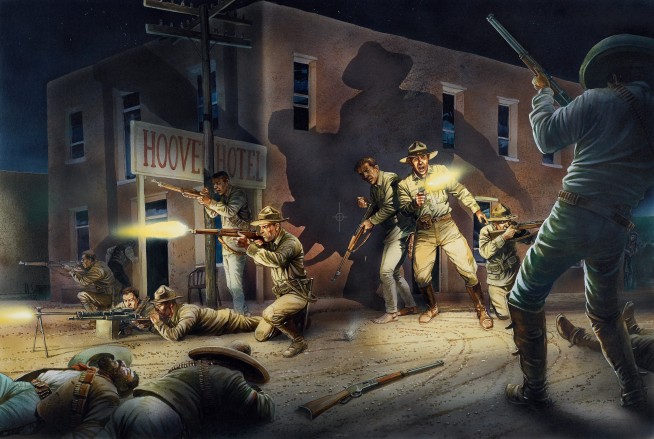
The U.S. response to Villa’s raid [on Columbus, New Mexico, 1916] also remains pertinent a century later, as it established a pattern of personalizing Latin American security threats that persisted for most of the 20th century. As I recount in my history of U.S. strategic manhunts, Wanted Dead or Alive, President Woodrow Wilson announced, “An adequate force will be sent at once in pursuit of Villa with the single object of capturing him and putting a stop to his forays.” The War Department issued orders for Brig. Gen. John J. Pershing to lead the expedition into Mexico.
On March 16, the Punitive Expedition entered Mexico. For the three months, Pershing and his men combed the deep canyons of the Sierra Madres in Chihuahua province — an area roughly the size of Virginia and the Carolinas combined — searching for Villa. Despite several near misses, Villa eluded Pershing. The Americans scored many victories over Villa’s forces, however, and killed several of his subordinates. (Gen. Julio Cardenas, the commander of Villa’s elite bodyguard, was killed in a raid led by then-Lt. George S. Patton).
By the time the Punitive Expedition was finally withdrawn, Pershing’s forces had scattered Villa’s band, killing 203, wounding 108, and capturing 19 of the 485 Villistas who had attacked Columbus. Although Pershing’s troops did not get their man, Villa was never again a serious threat to U.S. security.
Art by Peter Dennis.
Over the next 75 years, American policymakers repeatedly deployed U.S. forces to Latin America with the operational objective of killing or capturing an individual in order to counter a perceived security threat. From 1927 to 1933, U.S. Marines pursued Nicaraguan guerrilla leader Augusto Sandino after he targeted Americans enforcing the peace treaty that ended Nicaragua’s civil war.
In 1967, U.S. Green Berets trained the Bolivian Ranger battalion that — with the assistance of CIA operatives — captured and killed Marxist revolutionary Che Guevara. Twenty-four thousand U.S. troops invaded Panama in December 1989 to arrest strongman Gen. Manuel Noriega on drug trafficking and racketeering charges after he threatened American citizens living in Panama. And in 1992, elements of Delta Force were deployed to Colombia to help police hunt down Pablo Escobar, the vicious kingpin of the Medellin drug cartel who was finally killed in December 1993 (a top secret U.S. military intelligence unit had been involved in the hunt for Escobar since 1989)…
… It is tempting to view Pancho Villa’s raid 100 years later through a hazy lens of romance and nostalgia for the days of a lawless frontier. Yet in reality, the attack on Columbus epitomized a threat that has not disappeared, but evolved into more complex and perhaps pernicious manifestations. Beyond the possible remedy of building a border wall — which will still be susceptible to evasion by tunnel-building — U.S. policymakers must continue to seek ways to address the causes of this problem, not merely its symptom, by building the capacity of Central American military and police and by strengthening the institutions that enable our allies to address potential threats before they reach the U.S.–Mexican border.

Quixotic Mainer says
The bolt and lever article was great! Everytime someone mentions a Vetterli, I recall having an opportunity to buy one inexpensively, in phenomenal shape. At that time I doubted my ability to make my own .41 Swiss and demured. You certainly wouldn’t see every other guy lugging one of those at a SASS shoot though!
I’d like to read that Manhunts book as well, I’ll tack it onto the list.
JimC says
Ah, the ones that got away…
Runkles’ book is worthy. There are those who argue that going after HV targets is misplaced — citing the “kingpin strategy” of going after top narcos as an example of why it fails. But Runkles makes a pretty good case that, while there’s been mixed results historically, our strategic manhunts have helped accomplish strategic objectives. The Villa example is on point, I think: We didn’t get him, but he was no longer a threat to the U.S. People downplayed bin Laden’s importance (including GW Bush when we missed him at Tora Bora) but the intel gathered in Abbottabad showed clearly that he was still in the fight, and it was beneficial to take him out. Then, of course, there is the legitimate matter of justice and revenge.
Anyway, I remember it a good read and I need to revisit.
Joe says
Thanks for the shout out! I haven’t been commenting as much lately due to life being hectic, but I’ve been reading!
When writing this article, I looked at your write ups on some of the lever guns used by Pancho Villa as well as the Remington Keep. Definately recommended for readers who haven’t checked it out! https://frontierpartisans.com/9837/keen-remington-keene/
JimC says
Always good to hear from you Joe.
Ugly Hombre says
https://historycollection.com/nobodys-hero-9-inconvenient-truths-che-guevara/
It’s kind of funny that most Baizou’s running around in Dead Che T- shirts are exactly the type of people he would shoot for fun.
1 – Retribution against the Former Cuban Regime Was Brutal
2 – He Enjoyed Killing
3 – He Wasn’t a Guerrilla Mastermind
4 – He Helped Ruin Cuba’s Economy
5 – He Didn’t Have a Medical Degree
6 – He Was a Racist- via his own words
7 – He Hated Homosexuals
8 – He Was an Adulterer. Had his way with the maids.
9 – His Death was neither Brave nor Noble
Addendum: 10. He was a stinky fellow who bragged about not taking a bath for six months.
Felix Rodriguez was old CIA the Anti Communist version not the version that voted for Gus Hall a Soviet agent in 1976 when the Khmer Rouge were murdering million in Cambodia.
He had plenty of good reasons to hate Castro and Che and all Communist mofos.
https://www.cubanet.org/htdocs/CNews/y09/enero09/23_O_3.html
“The former political prisoner Pierre San Martin, eyewitness of the murder in cold blood of a boy between 12 and 14 years of age carried out by the abominable monster of cruelty Che Guevara in La Cabaña fortress in 1959: “…the sound of the iron door opening was heard as they threw another person into the already crowded cell…. And what did you do? we ask almost in unison. With his bloody and beaten face he stared at us and responded “I defended my father so they wouldn’t kill him, I couldn’t stop it. Those sons of bitches murdered him.”
Near the wall where they conducted the executions, with his hands on his waist, paced from side to side the abominable Che Guevera. He gave the order to bring the boy first and he ordered him to kneel in front of the wall. The boy disobeyed the order with courage that words can’t express and responded to this infamous character: “If you’re going to kill me you’re going to have to do it the way you kill a man, standing, not like a coward, kneeling.”
Walking behind the boy, Che said “whereupon you are a brave lad”… He upholstered his pistol and shot him in the nape of the neck so that he almost decapitated him.” [6]”
https://www.aporrea.org/imagenes/2012/01/mercedes_benz_y_el_che.jpg
I knew some Cubans in the service who told me what happened to them after the Communist Revolution I know some Cubans who still go back there- its a Communist chit hole that once had a high standard of living and a booming economy until Fidel and Che fooked up the country.
https://www.aporrea.org/actualidad/n196471.html
He hated Capitalists, Gay’s and was a racist- according to his writings but wth guess you can’t fix stupid. He would have gladly hung the Mercedes suits or shot them. lol
Greg Walker says
Felix R recieves a great deal of credit regarding the capture of Che.
In actuality, it was then CPT Gary Prado, of the Bolivian Army, who deserves the lion’s share of recognition. Prado, who rose to the rank of General, wrote a book on the operation that is extraordinary in detail and humbleness.
And it was Prado whom Che gave his Rolex GMT to before he was executed, not Rodriguez. Prado, as he’d promised to, returned it to Che’s wife in Cuba.
The GMT Rodriguez has belonged to another guerrilla leader in the band who’d also been captured.
Prado recounts this in his book.
Also overlooked are the Bolivian Rangers, trained in Bolivia by Special Forces Legend, “Pappy” Shelton and other “Green Berets” from the 8th Special Forces Group, who ran Che and his band to ground.
Che’s demise was hastened by the Argentine goverment who knew if he was successful in Bolivia, he would establish guerrilla bases in Bolivia to wage an insurgency in his native country. Intelligence and logistical support from Argentinia proved invaluable.
Finally, Che’s persona, appearence, intellect, and courage saw him accomplish significant victories against Batista’s army during the Cuban revolution. But he was a hardcorps Stalinist and he thought and acted as one.
And his mythical / iconic Being created by Communist propaganda still inspires revolutionaries, activists, and “small wars” around the world.
We studied his work, writings, doctrine, defeats and victories when I was in Special Forces. If you don’t respect your adversary…he can and will ultimately defeat you.
JimC says
Great stuff Greg. Thank you.
SQUIRE RUSTICUS says
As per an editorial by Jack Anderson of the Washington Post in 1979, and conversations I was privileged to.
General Manuel Noriega was targeted for “removal”, by the Special Operations of the DEA (my grandfather was then Director), BUT was protected by our own government. Everyone knew what Noriega was.
As a side note: I had a friend serving in the US ARMY a few years before the invasion, and it was not uncommon for Panamanian troops to shoot at US soldiers as harassment out in the jungle during training operations.
President Richard Nixon envisioned the DEA as having the capability to “cut the head off the snakes”. The law enforcement part of the DEA sabotaged the operations of the former Agency personnel brought into DEA. Another 10 years, when Noriega was less valuable, suddenly we had an invasion, it cost many lives, tons of money, Noriega went to prison, the people of Panama suffered.
BUT we are not suppose to do uncomfortable things I guess ….
Che needed to die for all of the reasons mentioned before, and more. Supposedly he got glee from shooting ex-military officers, businessmen of the middle class, the wealthy that had not fled. Enough so Castro feared his blood lust and growing popularity. Sent him off to spread the revolution. I’m always perplexed when I see a college kid with Che’s tattoo on their arm, or wearing a t-shirt with his photo. Then again, I saw a guy wearing a Pol Pot t-shirt at University in the 80’s, and I thought “Dude, you’re hero would kill you just for going to College and for your eye glasses.
Hygiene:
Mao, didn’t take baths either, or brush his teeth, but use tea to clean his teeth. Supposedly he liked to deflower rural peasant girls and spread diseases from his lack of hygiene. It’s cool to be the Talking Head…. Don’t know what is up with Revolutionarys and not being clean of body ? It is one of the first areas we learn in the field, for a happy life.
JimC says
My god — Pol Pot? That makes me sick.
Matthew says
There is a long tradition of Marxists not bathing going back to Marx himself who also did not bath.
I once went to a Chinese restaurant in New York and went looking for a bathroom. I passed a painting of Mao on the wall. It was like going to a German restaurant and seeing Hitler on the wall, frankly.