Worn out and demoralized by separation from their families, the bronco Chiricahua Apaches led by Geronimo and Naiche, the son of the great Cochise, surrendered for good on September 4, 1886.
Thus ended the Apache Wars.
Well, not quite. Even as Geronimo gave up moving like the wind across the desert southwest and northern Mexico, there were other Apaches hidden in the fastness of the Sierra Madre who would not turn themselves in to be exiled to Florida. And among Geronimo’s warriors was one who just could not bring himself to surrender.
Adelnietze was a hardened warrior. Ace Apache Wars historian Edwin R. Sweeney identifies him as one of the warriors who tore through New Mexico and Arizona in 1885 in Ulzana’s epic raid. He’d been photographed by Tombstone, Arizona, photographer C.S. Fly in March 1886, in Cañon de los Embudos in Sonora, Mexico, as Geronimo negotiated a surrender to General George Crook. That surrender didn’t stick, and the Chiricahuas would run rampant for a few more months.

A warrior to the end.

Adelnietze, center, photographed by C.S. Fly in 1886, in Geronimo’s camp.

Adelnietze, standing second from left, was one of the last holdouts with Geronimo and Naiche (far right), who was probably Adelnietze’s cousin and was considered a brother.
The photographs of Adelnietze portray a true warrior, a hard man and a killer, his stern and dignified visage bisected by a stripe of white paint; well-dressed and well armed with a Trapdoor Springfield carbine and a revolver with a birdshead grip, perhaps of ivory or pearl, with a lanyard dangling from the butt. He wears the traditional Apache headband and boot moccasins, and a buckaroo-style neckerchief secured by a concho slide. His hands are poised across his concho-studded gunbelt.
It’s a safe bet that he took much of his clothing and equipment from Mexican men he had slain in raids that tore a red swath across northern Sonora. Geronimo’s Apaches had made Mexico howl.
Geronimo and his tiny remnant band with just a handful of adult warriors had not been captured, though they had been pursued relentlessly by thousands of American and Mexican troops and scouts, who had authority to cross the international border in pursuit of the renegades. The Apaches were simply tired of living on the run, and they knew that their families had been packed off to far away Florida. For all their fearsomeness as warriors, the Apaches were family men — they yearned for their wives and children. The desire to be reunited finally won out over low-down freedom, and they gave themselves over to the forces of General Nelson A. Miles at Skeleton Canyon in Arizona.
Not Adelnietze. His wife had gone out with him on the warpath and evaded being incarcerated and exiled, so he lacked the incentive of his brothers to lay down his rifle. He and two other warriors, identified by historian Lynda Sanchez as the warriors Natculbaye and Satsinistu, along with three women, slipped away from Skeleton Canyon into the mountains. Adelnietze would roam and raid, a free man, for another 10 years.
••••
In his old age, Geronimo sometimes expressed regret for surrendering. He had two wishes: that he had killed more Mexicans and that he had died on the warpath. Adelnietze would not have to live with such regrets.
Sanchez notes, in a story in True West Magazine, that:
Adelnietze did not know about the horrors being heaped upon his brethren in the hellhole prisoner of war camps in Florida, Alabama and later Oklahoma Territory. No doubt he missed his kin, but at least he was free to smoke a cigarillo, take a cow when needed or trade with Mexicans. Perhaps he had turkey quills filled with gold dust to purchase supplies from willing traders. This fragile existence was much better than anything Naiche and Geronimo endured. But then the Apache murders of Horatio Merrill and his 16-year-old daughter in December 1895 and of Alfred Hand in March 1896 became the last straw.
It can’t be known for certain that Adelnietze was responsible for the Merrill killings. There were other bronco Apaches out there in the still-wild deserts and mountains of the bloody borderlands — not least of them the notorious Apache Kid. However, circumstantial evidence indicates that the murders can be laid to Adelnietze, who was by then raiding in the company of another famous Apache fugitive named Massai. The Chiricahua fugitives were stone killers.
The U.S. Army determined to make a springtime sweep of the borderlands to eliminate the raiders. Rancher John Slaughter led a posse into the field on the same mission.
Apache scouts, along with the legendary Mexican scout Merijildo Grijalva, who had been tracking Apaches since the days of Cochise in the 1860s, picked up the fugitive raiders’ trail. Two patrols of the 7th Cavalry converged on Guadalupe Canyon, where the scouts had located a Rancheria embedded in the rough and rocky terrain.

A panoramic view of Guadalupe Canyon, published in True West Magazine. The haunted stretch of rugged desert had a bloody history.
Guadalupe Canyon was a place of blood. A funnel that ran across the corner where Mexico, New Mexico and Arizona meet, the canyon was trafficked by raiders and rustlers of three nations — Apache , American and Mexican — and had seen its share of battle and massacre. In 1881, Mexican vigilantes had attacked a camp of American cowboys they believed to be rustlers and they slaughtered Old Man Clanton and five other men in their bedrolls. Geronimo had fought U.S. soldiers there while making one of his many breaks for Old Mexico.
It is not at all clear whether the U.S. troops pursuing Adelnietze were still in Arizona or had crossed into Mexico. At that point in 1896, there was no border-crossing agreement in effect, so if they were in Mexico, they were there illegally. Not that anyone particularly cared.

Guadalupe Canyon. True West Magazine.
The cavalry units and their scouts approached the renegades’ camp early on the morning of May 17, 1896. They were under orders not to harm the women, who were expected to give themselves up when the men went down. One of the women sounded an alarm and Adelnietze appeared.
The troopers and scouts opened fire and Adelnietze took a bullet. The Apaches, as befit their custom and their training, immediately scattered into the rocks and side canyons.
The patrols had failed to establish a blocking force in the right position, and Massai escaped clean. So did the women.
The only trail the scouts could pick up was a blood trail from the severely wounded Adelnietze. They tracked him to a spot where the ground was saturated with blood and they found a pair of bloody leggings — Adelnietze’s tall Apache moccasins.
These, along with an 1873 Springfield rifle with a shortened barrel, a pair of field glasses, bows and arrows and some clothing, were seized as trophies. The short, sharp, but indecisive action was the last significant military action against the Apaches. There would be violent episodes lasting well into the 1930s, but they would all involve civilian vigilantes or legal authorities.
A couple of days later, a patrol found the body of Adelnietze where he’d bled out from his wound. He’d had a 10 year run after the official Apache surrender and died the way Geronimo wished he had — on the warpath to the end.

deuce says
What a fighter. Oddly enough, I’ve known at least one guy who was a dead ringer for Adelnietze. Of course, I grew up just 15mi north of Oklahoma…
JimC says
Could be…
Matthew says
Fighting to the end is romantic and takes a great deal of courage, but it’s hard life and I wonder if it did anyone any good.
About the picture, I’ve never seen a picture of an Apache warrior that did not look really badass.
JimC says
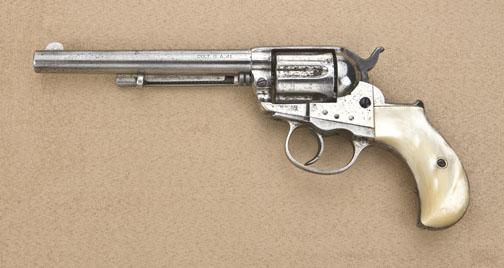
I believe the revolver is an 1877 Colt .41 Thunderer.
john roberts says
I agree about the thunderer. It looks like there is a design on the grip. Too bad it’s too vague to make out. It might establish whether he took it off a dead American or a Mexican.
John C. says
Better to die on your feet than to live on your knees.
As always, Jim, really good stuff. Can’t wait for Part II!
Bro John
lane batot says
Now I’m sure I musta seen the name Adelnietze in all my voluminous reading and collection of Apache-oriented books over the years, but never specifically featured in a way I’m more likely to now remember thanks to this spotlight on this equally interesting individual posted here–just like the specific mention of Juh involved in the Preston fight mentioned earlier(though I surely came across mention of THAT repeatedly, too, just not featuring Juh!)–one thing I love about “Frontier Partisans”! A lot of these posts could/should be combined and put in book form–is that what “Warriors Of The Wildlands” is like? I haven’t yet seen a copy of that publication…..yet.(ahem!). And I, too, am looking forward to “Part 2”. I ordered(haven’t got it yet) another book(a newer novel) about Maassai recently–talking about FP sink-wren-awe-city!
JimC says
That’s what I’m shootin’ for.
Iain Hearfield says
I’ve only just discovered this site and this thread is intriguing. I’ve been reading about the Indians history for over 60 years and managed to visit Arizona some 12± years ago. However, the point .. I’m responding to the thread that goes back to 2017. WARRIORS OF THE WILDLANDS and the mentioned Part 2 to this article (did that ever surface?)and the mention of a newer ‘novel’ about Maassai(yarn or non fiction?)? Where do I find these books/articles? Looking forward to any advice. Great site.
JimC says
Welcome to the campfire Iain. you’ll find Part II here and Part III here.
Warriors of the Wildlands may be ordered through Paulina Springs Books (just a few left) at https://www.paulinaspringsbooks.com.
Thanks for your interest.
Jim says
I apologize in advance as I am a bit of a Luddite at heart but I am not able to find out where to buy your book. I thoroughly enjoy your work and would like to purchase a copy. As a F R Burnham fan for the last 26-27 years I constantly in search of similar stories – keep up the good work
JimC says
No apology required — thanks for your interest!
Two options: Send check for $24 (book + shipping) to:
Jim Cornelius
P.O. Box 461
Sisters, OR 97759
Make note of any inscription you’d like to have. I’ll throw in a Frontier Partisans morale patch.
— or —
Order from:
Paulina Springs Books
Sisters, OR
541-549-0866
Black Tyrone says
Most interesting article.
JimC says
Thank you sir!
Juan C Lopez says
Just a comment good website will return to it and look some more interested in the Apache culture after Geronimo surrendered and the ten Apache went to live in Mexico Sierra Madre
JimC says
Thanks for stopping by the campfire Juan.