Some element of synchronicity — or perhaps just algorithmic engineering — recently started throwing First Blood up into my internet feed. I realized that I have never addressed this important cultural touchstone of Frontier Partisan Continuity & Persistence.
I cannot recollect whether I read the novel before I saw the movie in 1982. They are different beasts, and that seems important, but I’m not going to be able to untangle them in 40+-year-old memory. I do have a strong memory of reading the novel in the Wrightwood cabin. It was this edition:

No Stallone. The cover image reflects a different Rambo from the character in the film.
The premise of the story is simple and classic, archetypal: Rambo, a Vietnam veteran — a Green Beret awarded the Congressional Medal of Honor, in fact — drifts into a town that doesn’t want drifters. He gets athwart the local law, gets hooked up for vagrancy, and — beset by a PTSD reaction — makes a spectacular and violent jailbreak and flees into the surrounding wild country. A chase ensues, and soon the hunters become the hunted.
The experience of novel and film were pretty much right on top of each other when I was 16 years old, and on fire with historical passions lit by The Frontiersmen and Give Your Heart To the Hawks. Of course, I experienced First Blood as a frontier yarn. And, of course, it was. In the January 2026 edition of Saddlebag Dispatches, First Blood author David Morrell and George “Clay” Mitchell dive into this explicitly and in depth:
He didn’t sit down to write First Blood and tell himself, “I’m going to write a Western.” He sat down to write a novel about a veteran, a young man coming home, carrying a war inside him, colliding with a country that can’t decide what it believes about itself. And only later, stepping back from the work, did he recognize the shape beneath it.
“A stranger comes to town,” Morrell said. “The sheriff doesn’t like you. Now our guy is in jail, but he breaks out, and this sheriff leads a posse after him. This is material that we have seen in other contexts.”
… “The contrast between the settlement and the wilderness,” [Morrell] said, “is a very powerful narrative drive. When the stranger comes to town, it upsets all that.”
That “stranger” can be a gunfighter whose time has passed, drifting into a place that wants his skills and resents him for having them. It can be the scout figure that American literature has been reworking since Natty Bumppo: the man who does not fully belong to either world, the man who keeps moving because stopping would mean choosing. It can be a decorated veteran coming home to a country that can’t decide whether to thank him or fear him.
Morrell is a very mindful writer. An academic whose thrillers carry literary aspirations, he uses symbology and sometimes outright allegory with deliberation and intent. It’s not an accident that the Rambo of the book is wearing a fringed buckskin jacket or that he flees from incarceration into the deep, dark hills of (almost) eastern Kentucky.

*
First Blood was written in the depths of the Vietnam War, and published in 1972. Morrell explicitly endeavored to tell a story in which the war came home. The novel is dark and visceral (in a literal as well as a figurative sense). The novel is far bloodier than the movie, which is unusual, and the violence was depicted so vividly that a Time Magazine reviewer called it “Carnography.” The Saddlebag Dispatches article notes the profound influence of Peckinpah’s The Wild Bunch and its brutal violence had on Morrell.
Rambo (who didn’t have a first name until the movie) is not a sympathetic protagonist. He is angry, sarcastic, and deeply psychologically damaged. He has killed at least once in America before the events of the novel unfold. His antagonist, Wilfred Teasle, actually attempts to act with some forbearance in dealing with Rambo when he drifts into town, and is increasingly frustrated at Rambo’s apparently deliberate provocative behavior. Throughout the build-up to the explosive jail-break at the end of part one of the novel, Rambo engages in an internal dialogue, with an interior voice urging him to stand down and walk away while a countervailing impulse drives him to seek, to insist upon, confrontation.
The two men are, in a real sense, both protagonists — Teasle a Korean War veteran who was able to integrate back into American society, though not without some sadness and pain of his own, and Rambo, a Vietnam veteran who could not — not least because that society itself did not know what it was anymore. Teasle’s America was fading, and Rambo’s America was broken, fragmented, and more than a little bit crazy.

Once violence is initiated, it can’t be pulled back. The two men are doomed to enact the roles that the gods of war have laid out for them. And it all ends badly. Both men die. Rambo is put down by Col. Sam Trautman — a deliberate play on Uncle Sam — like a trained fighting dog that has gone rogue or rabid. The whole thing is bleak in a way that much of the art of the 1970s was — and it’s compelling. Everybody knew it would make a great movie — but it took 10 years to get there, and in that 10 years, the story changed, and so did America.
*
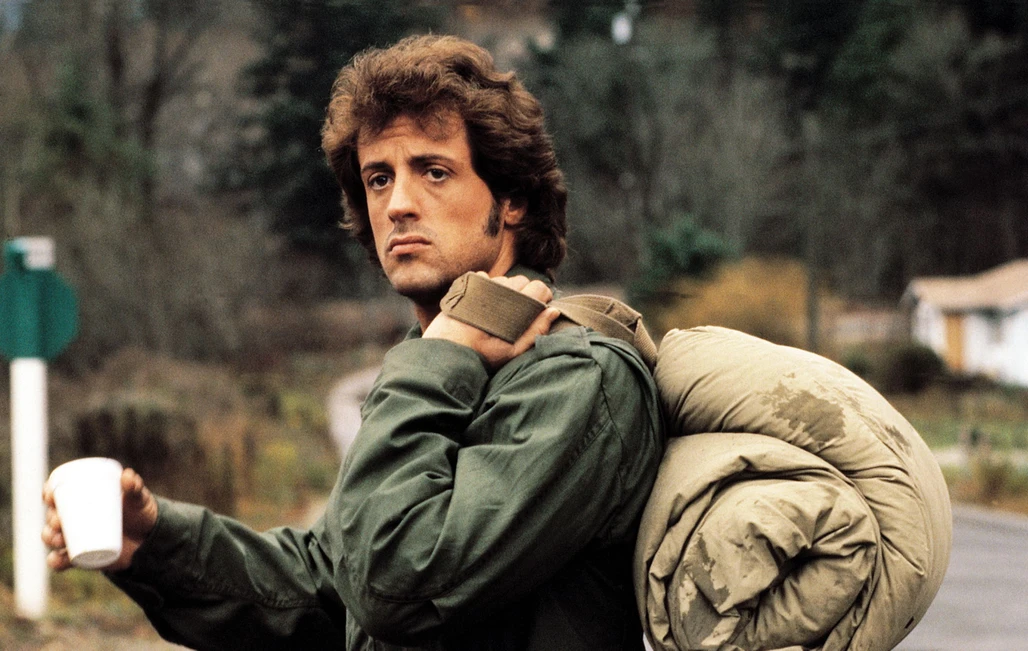
When I told my friend Craig Rullman that I was working up a post on First Blood, he proposed that we get together for dinner and a re-watch of the movie. So Lady Marilyn and I joined Craig and Wendy for Mexican food and a trip back to the early ’80s. I saw First Blood more than once, and had some indelible images from it imprinted in my memory, but I hadn’t watched it in decades. The movie holds up. But man, it is a very different story from the book. Rambo is recognizable — but recognizably different. For one thing, he’s got a full name. His first name is John, and Trautman calls him Johnny. He’s got a reason to be in town — he is visiting an old Army buddy, who, unbeknownst to him, withered away and died of cancer, implicitly due to Agent Orange exposure.
The opening scene reflects a profound change in outlook on Vietnam veterans that had evolved in the decade between book publication and movie release. The culture had largely recognized that, no matter how one might feel about the Vietnam War, blaming the men who fought it was out of line. Art and culture was beginning to see Vietnam veterans as themselves victims of the war (which carries its own distortions) and the Agent Orange scene evokes that. It also gives John Rambo a tether to humanity that the Rambo of the book does not have.
Morrell’s Rambo is very young still, in his early 20s, and looks like a derelict, like a wanderer who has been sleeping in the woods for months. Sylvester Stallone’s Rambo is fit, handsome, mostly clean-shaven, and, as Lady Marilyn pointed out, has great hair.
Where the novel alternates point-of-view between Rambo and Teasle, the movie entirely adopts Rambo’s POV, which renders Teasle a complete antagonist. Deputy Galt is such a piece of shit you are rooting for him to get his just deserts; and all of Rambo’s actions can be justified and, compared to the book, are actually restrained. The relationship between Col. Trautman and Rambo is much warmer in the film.
The change of setting from Kentucky to the Pacific Northwest (shot in British Columbia) does not materially affect the plot, but it does give the movie some exceptional visuals that emphasize wilderness as not just a setting but a catalyst for the action. Rambo is at home there, perhaps most himself there, while the agents of civilization are … not. The action sequences are spectacular, but are grounded in reality; Rambo is not a superhero, just a highly trained, capable wilderness warrior. I, of course, nerd out on a scene where a trapped Rambo jumps from a cliff into the limbs of a tree to escape — which mimics a scene from the folklore of Daniel Boone’s long hunt in Kentucky.
From the late 1960s into the early ’80s, Green Berets were depicted as the pinnacle of the U.S. Army’s elite, a cultural status that has since migrated to Navy SEALs and Delta Force. In the movie, Rambo is given a totemic weapon — a “survival knife” created by Jimmy Lile, Arkansas Knifesmith. The “Rambo Knife,” which symbolized Rambo’s wilderness guerrilla status (and did not feature in the novel) kicked off a craze like Davy Crockett’s coonskin cap and Dirty Harry’s .44 Magnum. It is symbolic of the fate of the franchise that the Rambo Knife got increasingly outlandish with each sequel. I can say with some pride that even as a teenager, I did not want a knife that didn’t have a full tang.


On re-watch, we all agreed that Stallone really sent it with the “Nothing is over!” monologue at climax of the film. There was a lot going on in that set-piece scene that reflected the way America was seeking to come to terms with Vietnam.
*
My understanding is that First Blood was intended to be a one-off. The only reason that Rambo didn’t die in the end was that a test audience hated a scene in which he commits suicide. The movie ended with Trautman walking Rambo out of the police station Rambo tore apart with an M-60, past a wounded Teasle, who is being loaded into an ambulance, presumably to survive. The scene isn’t hopeful, exactly, but it isn’t bleak. And when First Blood proved to be a major hit, Rambo’s survival opened the door to sequels.
Perhaps I’ll take a dive into the sequels some time. There is some interest there, especially in Rambo II as part of a genre of goin’-back-to-Vietnam stories that proliferated later in the 1980s. But those films are a far cry from what First Blood was as a movie, and completely unrelated to what Morrell was doing in his debut novel. (Morrell wrote the movie tie-ins, which is interesting. I don’t blame him for cashing in, but he had to set aside his original vision, and he did so quite matter-of-factly).
Few writers are as willing to talk in-depth about their process, their intent and their work as Morrell. Here he speaks at great length with Jack Carr, who was profoundly influenced by Rambo and other Morrell novels as a kid — and now as a thriller writer in his own right.
I would be remiss if I did not include this fine analysis, which, in part, sparked my interest in revisiting First Blood:
Notes in the margin:
• The cultural impact of Rambo is hard to overstate. While First Blood carried a lot ambiguity, the subsequent movies were self consciously mythic (I haven’t seen the more recent films that supposedly tacked back toward the original tone, so I can’t comment on them). Rambo served a need in America to feel potent again — and that went all the way up to the top.
From UPI, June 30, 1985:
WASHINGTON — President Reagan, in a microphone test before delivering a statement on the release of the Beirut hostages, joked that after seeing the movie Rambo’he knows what he will do if Americans are taken hostage again.
“Boy, I saw Rambo last night,” he said before his nationally broadcast speech. “Now I know what to do the next time this happens.”
• Bruce Springsteen, whose own work of the early-to-mid-1980s grappled with Vietnam, evoked Rambo’s look when he hit the road for the Born in the USA tour considerably more jacked than he was before…

• Why, oh why did they not just give Rambo a Randall Knife and call it good?


John M. says
Thanks for this analysis, Jim. I grew up post-Vietnam, and Gulf War I was the first war I was really conscious for. The way even opponents of Gulf War I went out of their way to “support the troops” was pretty conspicuous, even to a kid. Looking back, I think even my (ex-)hippy teachers felt guilty about the way the Vietnam vets had been treated. Poor treatment of the Vietnam vets had really become part of the American mythos by 1990. I wonder how much of that was due to the Rambo series.
JimC says
It was certainly part of it. That “Nothing is over!” monologue got a LOT of attention.
Quixotic Mainer says
Wearing a fringed jacket in the 70’s wasn’t as odd as it would have been later, which is probably why they did the field coat for 80’s audiences. My Dad tried to bequeath me his old fringed jacket from that heady period, but I grew much wider shoulders, and it would never have fit me past 8th grade.
Have you seen Seraphim Falls? Neeson and Brosnan were odd picks for a western, but I thought they did a great job. The escape, evasion and survival aspects of the film reminded me of Rambo, there’s even a callback to an old war and a massive signature knife.
JimC says
Yes!
Some scenes were filmed on the McKenzie River at Sahalie Falls and Koosah Falls, which are favorite places of ours.
Quixotic Mainer says
Oh that’s awesome!
Greg Walker says
Jim – “Rambo” came out in October of 1982. I’d just arrived in Panama, assigned to the 3/7th SFGA at Fort Gulick. It was in the on-base theatre when released and of course a bunch of us went to see it.
We mostly thought it was a fun movie – entertainment – and one of the phrases that came out of it for us down there was “Now don’t go all Rambo on me!” Tongue and cheek.
Unfortunately the General Public as happens all too often came to see the character as a realistic depiction of what a “Green Beret” was – and that tag came to haunt many of us in various ways over the years.
I read the book before I saw the movie. And was, for that reason, disappointed in the film and its ending. Morrell delved into real issues and his character reflected those issues.
In the book Trautman shoots Rambo in the head with a shotgun. This after Teasle and Rambo have been mortally wounded but Rambo manages to get away. His attempt, again a depiction of veteran suicide, to take his own life is motivated by his realization he’s wholly lost his bearings and place in society. Trautman shoots him as an act of mercy – knowing as he does the man will die a thousand times over if he survives and goes to prison.
Morrell uses suicide in the sense of ritual seppuku. “Seppuku (or hara-kiri) is a Japanese ritual suicide by disembowelment, historically practiced by the samurai warrior class. It was considered an honorable way to die, often performed to avoid capture, protest a leader’s actions, or atone for a serious offense.” Additionally, “n the ritual of seppuku, the assistant who cuts off the individual’s head is known as a kaishakunin. This role was established as an act of mercy to end the prolonged agony of disembowelment, which was otherwise a slow and painful way to die.” A specific sword stroke was necessary to cause the severed head to fall forward into the dying man’s lap rather than land on the ground. A great deal of expertise with the sword was required to make this stroke.
Trautman plays the role of the kaishakunin. His responsibility was to ensure the death was swift and clean – to avoid the humiliation of death throes or if the act of cutting open the abdomen of the Samurai warrior was somehow botched.
The entire ritual was meant to save face.
Rambo knew he’d erred and had to atone for his actions. Trautman understood this and as a warrior himself he assisted his former teammate in accomplishing this. Sadly the film script left all of this imagery out.
Teasle himself was a contradiction. A veteran of the Korean war and awarded the Silver Star, Teasle indeed returned home and entered law enforcement – too often the closest thing many veterans have traditionally done in America believing it is a brotherhood as found in the military, especially Special Operations units. Teasle put his conventional force war behind him to make this transition and to check the right box civilian wise. His empathy was an antique of his service – and Vietnam was as alien to him as Korea was to our WW2 veterans who for years denied the reality of Vietnam as having been a “real war”. Teasle brought a law enforcement war to Rambo – hence this quote made by Rambo to Teasle – “”I could have killed ’em all, I could’ve killed you. In town you’re the law, out here it’s me. Don’t push it! Don’t push it or I’ll give you a war you won’t believe. Let it go. Let it go!”
It was the Vietnam veterans who pushed and fought and won in making combat induced PSTD a wound / moral injury – opening the door for the huge strides in care and treatment and “PTSD Growth” we’ve seen during and after GWOT. If the film did anything positive it pushed this aspect of military service in wartime to the forefront.
I’ve watched the sequels with the above in mind. I’ve enjoyed them as entertainment. I have retired SF Brothers who have chosen to live in Thailand simply because doing so is a simpler and more accepting way of life for them than living in the states. Many of them volunteer to work with the Vietnamese, Laotians, Cambodians, and hill people – they have become peace makers.
As for the Rambo knife (1st version). I met Jimmie Lile years ago. The film needed a big knife to show up on the screen and one that would draw attention. Randall originally offered (and still does) the Model 18 Attack-Survival which features a spear point blade, sawteeth designed specifically for ripping out helicopter fuselage siding, and a hollow handle for fire starter / tinder, and a compass in the end cap.
This was the Randall I bought in Fayetteville upon graduation from the “Q” Course.
The Lile knife was inspired by the Randall Model 18.
As for why Morrell wrote Rambo in 1972 – “David Morrell wrote the 1972 novel First Blood (later known as Rambo) to explore the intense psychological trauma of Vietnam veterans returning to a divided America, inspired by stories from his students and the 1968 riots. He aimed to bring the violence of the war home, highlighting the struggles of soldiers facing hostility in civilian life” – and as for the main character’s name – “The Apple: While struggling to name his protagonist, Morrell’s wife brought home a bag of Rambo apples. He liked the “sound of force” in the name. The Poet: He also associated the name with the French poet Arthur Rimbaud, whose work A Season in Hell felt like a fitting metaphor for the character’s experience.”
Rimbaud (French) is pronounced Ram-boh.
JimC says
Thank you for this Greg.
Matthew says
I tend to role my eyes when people talk about thriller writers, but Morrell is one I don’t.
Sadly, Robert Duval has died.
https://www.cbr.com/robert-duvall-dead-95/
The “Rambo Knife” comes up in the manga/anime The Fable. It’s about a hitman who takes a year off killing and has a mixture of comedic and really gritty crime adventures. The man who raised the protagonist to be a hitman gives him a “Rambo Knife” at one point.
JimC says
Posting on behalf of Lane Batot:
Did you never discuss “First Blood” film or book on the blog before? I could have sworn we discussed it at one time, but perhaps I’m confusing it with a discussion with someone else? Anyhoo, “First Blood” was a very influential movie for me, as I ended up relating to it(luckily not as violently or tragically!) in many ways. I most definitely saw the movie first–never got and read the book until decades later actually(and I thought YOU were the one who influenced me to get the book?), so my mind was already entrenched with the film story, and I’ve always liked it better, if only because the book had such a tragic ending! More realistic as that may have been. I saw the movie fresh from graduating college–five-and-a-half years of a last ditch effort to civilize me(I refer to it as “being sent o the Reservation for re-educating!”), during which time I had a virtual guerrilla war going on with the corrupt Campus Police at the school I was exiled to, deep in the Appalachian mountains(and those mountains, that I got to know like the back of my hand, were my salvation and escape from pursuit on many an occasion!). I had been terribly disillusioned to discover, in several unfortunate incidents, that all cops are not forthright, law abiding, honorable, self-sacrificing heroes, as I had been brought up to believe. I came smack up against small town corruption, abuse, and oppressive authoritarianism, which eventually, in my hot-blooded youth, had me take up the hatchet (quite literally!)with a vengeance! I still have the old, sturdy hammer/axe I used on countless numbers of my destructive raids! Although I ended up fighting over several issues, the number one involved “The Dog Pound War”(Jane Goodall’s favorite of my many tales, incidentally), where the cops virtually kidnapped local’s dogs and held them for ransom, and killed them brutally if their ransoms were not met. This was done with the excuse of “Animal Control”, although strays were never bothered, as there was no money in collecting a stray. Looooong story, that. I actually ended up WINNING that conflict, after five persistent years of constant guerrilla raids, and survived to get to see the Head of Security fired for another offense–and a marvelous celebration I had over that! I saw “First Blood” just after that, just before I went to Africa. Came back from Africa–a young, rough-looking fellow with long hair, and spent several years trying to fit in to society–never really did, I and my feral nature. I was never in the military, however–far too feral for THAT kind of organized control! I got “profiled” and pulled over and harassed a lot(especially so in rural Texas, where I ended up at one point!) by local, rural law enforcement–they always seemed ANGRY that they DIDN’T find drugs or something else incriminating that would allow them to arrest me. They still physically pushed me around and were less than civil with me, on some of those occasions, and all I could think of was “they are TRYING to provoke you–don’t go all “Rambo” and accomodate them!” Needless to say, more disappointment and disillusionment towards Law Enforcement–yet I at least never lost my respect for the INSTITUTION, and have ever afterwards judged police by their individual actions, and still found plenty to admire and respect so at least I had sense enough to never let the abusive bad apples prejudice me towards ALL Law Enforcement….to be continued…..
JimC says
Lane Batot continued:
…..So one could see where I absolutely LOVED the “Rambo” character! I have seen all the sequels, and no, they are not the same kind of story as the original, not by a long shot, but I feel compelled to see what the character has gotten into as the years have galloped by–and I and the character have grown old together! The sequels are at least good, heroic, bad-ass adventure stories, up against seemingly impossible odds and evil bad guys, that get their just desserts in the end. Unrealistic as they might be, sometimes one just NEEDS to see mythical stories like that!……And someone gave me one of those Rambo survival knives when that fad was going on–a neat concept, but my gift was, alas, a very cheap knock-off, that lasted only a very short time before it fell apart! At least I spent no money on it, and, well, it’s the THOUGHT that counts, you know!….One thing not mentioned regarding the influence of the story(especially from the films, no doubt) is all the DOGS that have ended up being named “Rambo”! Gosh, I’ve known of kuhzillions! Usually Rottweilers or Pit Bulls or such intimidating breeds–although–obviously as something of a joke–quite a few Toy Breeds! I’ve also always felt the character Rambo would have been less somber and troubled if he had just got him a good dog or two!
JimC says
Lane Batot continued:
And I suppose, after all that, I should at least mention how I finally managed to sort-of fit into modern society! Everyone used to say, quite independently on varied occasions and with nothing complimentary meant at all, that I “belonged in a zoo”! And what happened? I eventually fell into a zookeeper job(of the many bare minimal survival jobs I had experienced trying to “walk the white man’s road”), which I took to like a duck-to-water, and, like so many of the animals I care for, really had no other place to go in modern society!
Wayne says
The misfit/honorable veteran is an enduring character. I recently re-watched Lonely Are the Brave starring Kirk Douglas. It was based on Edward Abbey’s novel The Brave Cowboy. A great film, and according to TCM, Douglas’ favorite performance.
JimC says
That’s another one to revisit.
Jean says
This was interesting. I sometimes feel that reading the book is not a good idea if one plans to see the movie. The Brits do a better job of stick with the book than we do, but that seems to be changing as time goes on. I guess we all think we can do a better job than the guy before us.
Thanks for the article.
JimC says
Thank you Jean.
Greg Walker says
Of the sequels to First Blood I feel “Rambo 4” or “John Rambo” (2008) is the most thoughtful on many levels. They really should have ended the series with it.
“Last Blood” was pure exploitation of the genre. Terrible storyline and truly without merit, IMHO.
The “First Blood” knife became a milestone in the cutlery industry. It birthed many imitations and replicas, most of them poorly made / produced. But it sparked a huge interest in custom made and specialty production bladeware thanks to Jimmy Lile and later Gil Hibben. Even Al Mar at Al Mar Knives, then in Lake Oswego, offered a hollow handle survival knife, the SF-10.
Custom maker Jack Crain would design / make a hollow handle bowie style knife for the first Predator film.
Hibben’s fixed blade offering was again larger than life and meant for the big screen. It also went into mass production as a result. Stallone was so taken by Hibben that he had a very expensive Special Forces crest on a necklace made for him which Gil often wore to knife shows.
In short, the “First Blood” knife took on a life and impact of its own which is unmatched to this day.
I did find it interesting that in Rambo 4 the character forges a very simple but traditional (for the area he was living in) bush knife. “The Rambo IV machete is a, designed by Gil Hibben for the 2008 film Rambo. Unlike previous survival knives, this 18-inch weapon was made in D2 or 1095 steel and its handle wrapped in leather. It is a raw, functional design echoing the Vietnam era CISO SOG beaver tail machete. The introduction of this simple design did away with the fancy, hi-tech knives of First Blood and the Hibben fixed blade that followed.
Proving that Form and Function has long held its own in those cultures that use such a knife, especially in SE Asia, on a daily basis.
My favorite quote from the Rambo films comes from Rambo 4 during a conversation with the female missionary seeking to enlist his help to go into Burma.
“”Don’t Waste Your Life, I Did. Go Home.”
More than one combat veteran of our many recent wars has expressed similar thoughts and feelings once back in “the world” and realizing the war(s) fought were too often rooted in lies, misdirection, misinformation, and all about the almighty dollar.
For example, this current story regarding the VA and its revised policy regarding disability ratings and compensation.
Stars and Stripes – https://www.stripes.com/veterans/2026-02-17/new-va-rule-disability-ratings-20780685.html
“Thank you for your service”, indeed.
JimC says
This speaks to me.
Ugly Hombre says
Never have read “First Blood” have to rectify that someday. I liked the first movie and Rambo IV in Burma- Did not like the Afghan Rambo at all.
However Mea Culpa lol my favorite by far is Rambo V. Not in a serious fashion at all but because it was so bat chit crazy and non P/C to the hilt that I had to love it. Over the top bonkers a sort of John Woo meets Sam Peckinpah. Dastardly cartoon like bad guys a old hermit Rambo who live in a ranch house and burrows in like a badger etc. the complete enchilada. Like a Shaw Brothers pasta western melody.
It should have won a Oscar. ! J.K. lol
And he should have had a Bagwell Hells Belle Bowie imo. Wonder if Stallone has one in his massive collection?
Would not be surprised if he does..
JimC says
My friend Greg will be pleased to see a Bagwell citation.