Two British officers earned especially dark reputations during the American War of Independence.
Thayendanegea — Joseph Brant — the Mohawk War Captain earned the name Monster Brant through his role in the brutal, bloody raids that devastated the Mohawk Valley and pushed the frontier back nearly to the Hudson River. In fact, Brant was far from monstrous — he tried to moderate the cruelty of frontier warfare when he could — but his prominence and success as a war leader focused the fear and hatred of the Americans upon him.
Lt. Colonel Banastre Tarleton came to symbolize British perfidy and brutality, earning a dark reputation as the commander of an elite corps of light troops that slashed and burned their way through the southern colonies in the later part of the war. His reputation remained dark from the 1770s through the 20th Century. He would be caricatured as the evil sociopath Col. William Tavington in The Patriot.
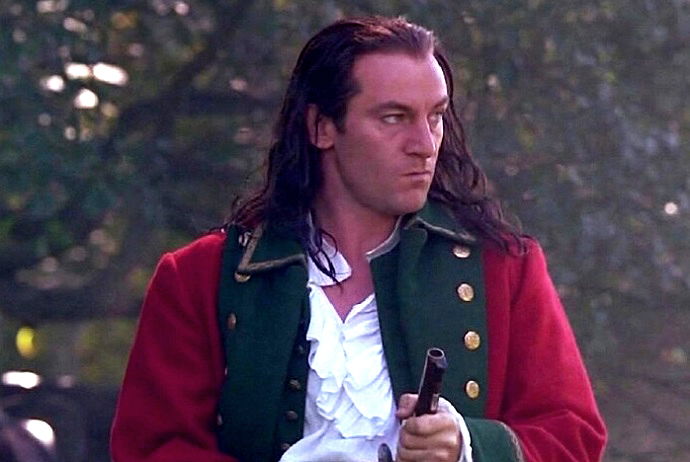
The real-life Banastre Tarleton was born into an upper middle class family who made their money in trade‚ including the slave trade. He was educated at University College, Oxford, where he displayed a remarkable level of athletic ability — and a taste for gambling and other “fashionable amusements.” He was charismatic, pleasure-seeking and, by the standards of the time, devastatingly attractive. He was intended for a career in the law — and destined for a life as a soldier.
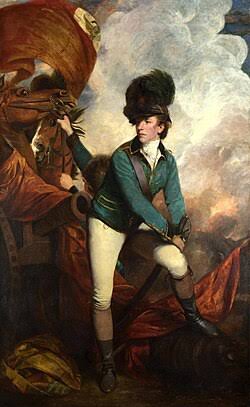
Portrait by Sir Joshua Reynolds, 1782.
He — or rather his mum — bought him a commission in the 1st Dragoon Guards in April 1775, just as the conflict in North America flared into real war. He was 20. He served with distinction as a cavalryman in the Northern Theater, notably capturing General Charles Lee in his bed in a tavern in New Jersey in 1776. He became a favorite of General Lord Charles Cornwallis.
When the British Crown adopted a “Southern Strategy” in 1780, hoping to end the war by conquering the southern colonies where there was supposed to be a great deal of Loyalist sentiment, Tarleton came into his own as a fast-moving, hard-charging commander of light troops, largely comprised of Loyalist volunteers, known as the British Legion.
The Legion concept combined light infantry, cavalry, and “flying artillery” in a self-contained combined arms unit capable of moving very quickly by 18th Century standards and engaging in independent action. It was perfect for chasing down Continental Army remnants after the British captured Charleston, and for anti-partisan operations against guerrilla outfits like Francis Marion’s and Thomas Sumter’s.
Tarleton drilled his men hard, and inculcated potent esprit de corps among them. The men of the Legion loved him for his gambler’s instinct, his flamboyance, and above all for his lead-from-the front courage and skill in battle.
*
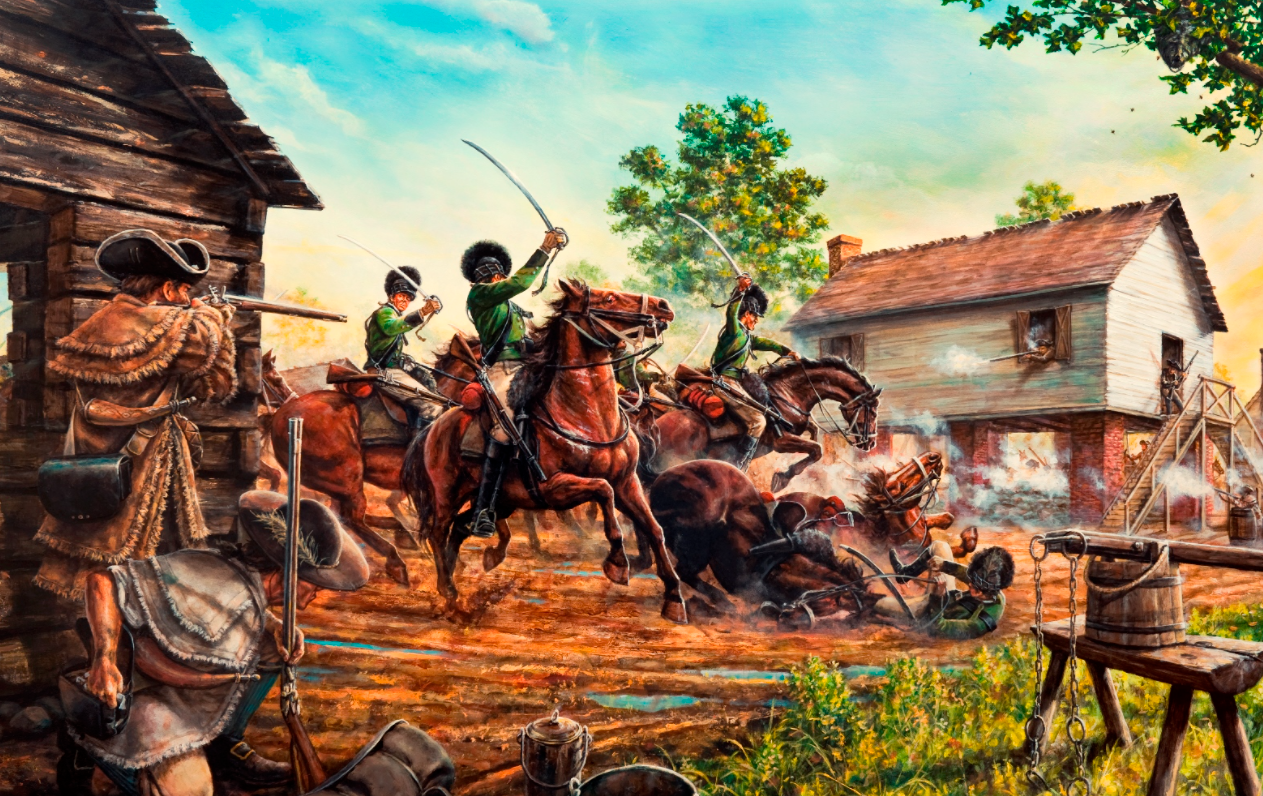
Tarleton’s Legion attacking an American settlement in the Carolinas. Art by Dan Nance.
The Legion’s esteem for their commander is the probable cause of the most notorious episode of Tarleton’s career: The Waxhaws Massacre.
The Legion was in hot pursuit of a contingent of some 400 Continental Army soldiers under Col. Abraham Buford that had escaped capture in the fall of Charleston. Tarleton drove his men 150 miles in 54 hours to catch up to Buford deep in South Carolina, and he only had about 200 men with which to engage the American force. Ever the gambler, he ran a bluff — he sent forward a truce flag and a one-time offer to take Buford’s surrender, claiming to have 700 men ready to fight:
“Resistance being vain, to prevent the effusion of human blood, I make offers which can never be repeated.”
Buford replied:
“I reject your proposals, and shall defend myself to the last extremity.”
Buford continued his march, and Tarleton continued his pursuit, his cavalry catching Buford’s rear guard and killing three Continentals. Buford turned to fight.
The forces got themselves into line of battle, with Tarleton taking personal command of the left wing of his force. Buford outnumbered the British force 2-1, but the Continentals were simply not prepared for Tarleton’s speed and violence of action. The Americans got off only one volley before Tarleton’s force was on them, and the Americans immediately tried to surrender.
Accounts are confused about what exactly occurred in what sequence, but it seems that at the same time the white flag went up, an American soldier fired on Tarleton and killed his horse, which went down with the Colonel beneath. The men of the Legion thought their commander had been killed — under a white flag no less — and they went into an immediate killing frenzy. Ultimately, 113 of the American force were killed and 150 wounded — most of them cut down by sabres as they grounded their muskets and tried to surrender.
The killing spree could be laid down to the common slaughter of a rout, or to infuriated indiscipline on the part of the Legion troopers. What it definitely was not was the cold-blooded execution of prisoners. That didn’t matter, though — the Waxhaws Massacre was a blow to the hard-pressed American army, but a gift of gold to Patriot propaganda. Tarleton was named The Butcher, and the results of surrender to the British were made plain. The term “Tarleton’s Quarter” became synonymous with ruthless, merciless butchery.
*
Tarleton engaged in a number of successful counter-partisan operations — though he was frustrated in his efforts to catch the Swamp Fox, Francis Marion. But the ruthlessness of the Legion in confiscating and destroying property worked against any effort to win hearts and minds. As in so many insurgencies across history, the harder the occupying power worked to snuff out resistance, the stiffer the resistance became.
Tarleton would suffer a major defeat when he went up against Rifleman General Daniel Morgan in the Battle of Cowpens. Morgan knew his man. He skillfully lured Tarleton — at this time in command of a substantial force in addition to his Legion — into a killbox. He had his militia fire and peel away, which prodded Tarleton into an immediate attack, which met stiff volleys from Continental Line troops. Then Morgan’s cavalry and infantry came in from the flanks and completely routed Tarleton’s force. The battle is legitimately regarded as a tactical masterpiece, which brilliantly turned Tarleton’s penchant for speed and violence of action against him.
Tarleton escaped from the battlefield, pursued by Patriot cavalry. He fought in a horseback melee with Col. William Washington — a cousin of George Washington.
Battlefields.org describes the saber-and-pistols action:
Again saber clanked against saber, and Washington’s sword was cut off at the hilt as he rose to stand in his saddle and parry a thrust from a British officer. As a British cavalryman moved in to finish Washington off, one of Washington’s African American combatants, who history has branded with several names, but who was most likely named Collins, shot the British officer in the shoulder before he could inflict damage on Washington. There was another thrust at Washington but another American cavalryman parried the blow with his saber. Tarleton joined the fray of the melee and took a swing at Washington, too, which Washington blocked with the hilt of his saber. As Tarleton reined up his horse he was surrounded by American cavalrymen, but made good his escape. As he fled the field of action he took a final shot at Washington which wounded Washington’s horse.
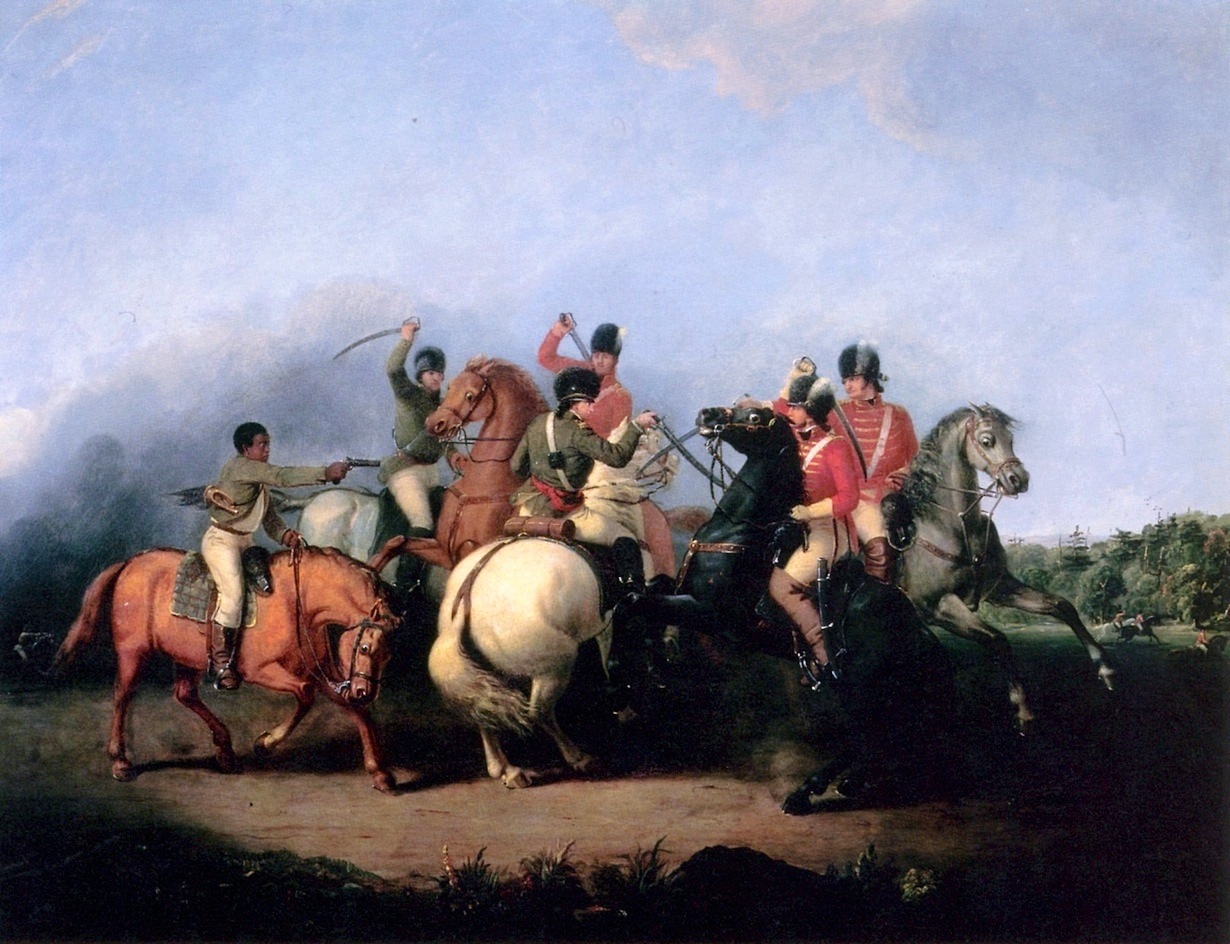
The Battle of Cowpens, by William Ranney.
Tarleton never quite got over the “devil of a whipping” that he took at Cowpens. He never took accountability for the defeat, from the day of battle to the writing of his memoirs years later. He blamed Cornwallis, he blamed the behavior of his own troops — but he never blamed his own aggressiveness and impetuosity.
The cavalry commander would continue to fight through the rest of the war, losing two fingers off his right hand in the Battle of Guilford Courthouse — a pyrrhic British victory that cost them 27 percent casualties and effectively wrecked the army, ultimately leading Cornwallis to hole up on the Virginia coast at Yorktown. When Cornwallis surrendered to Washington in October 1781, Tarleton’s war was over. At a dinner among the American, French and British officers after the surrender, Tarleton was refused a seat by the Americans, who regarded him as unworthy of their company. Such social slights were of tremendous significance in the 18th Century, and this one doubtless cut the cavalry officer.
When he returned home to Britain, however, he was hailed as a hero, and basked in all the blandishments that entailed…
*
Tarleton was not yet 30 when the war ended, and he had a lot of life left to live. That, of course, would be the high life. He rode and hunted like a country squire, and gambled and partied with a fast set that included the Prince Regent, who would become George IV. His friends knew him as Prinny. As in Prince, get it? Ah, those Brits.
Through this high-society set he met the beautiful courtesan, Mary Robinson, who had been Prinny’s mistress and now had a new “protector” called Lord Malden.
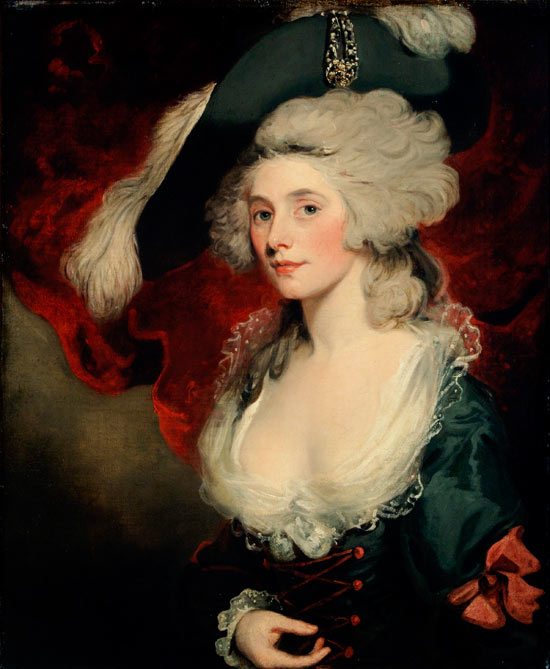
Mary Robinson as Perdita, by John Hoppner.
In Dangerous Liaisons style, Lord Malden bet that Tarleton could never seduce Mary. Tarleton went after the mission like one of his lightning campaigns, and had her in bed in short order.

Lord Malden was pissed that he lost the bet, Mary was pissed when she found out her seduction was on a wager — and Tarleton remained Zero Foxtrot. Mary got over it, and the two carried on a tumultuous 15-year affair. The British press delighted in the scandalous goings-on. A savage cartoon portrayed Tarleton regaling a (literally) feather-headed Prinny with war stories, while Mary is caricatured as a whirligig with her legs spread, offering “A la mode beef, hot every night.”
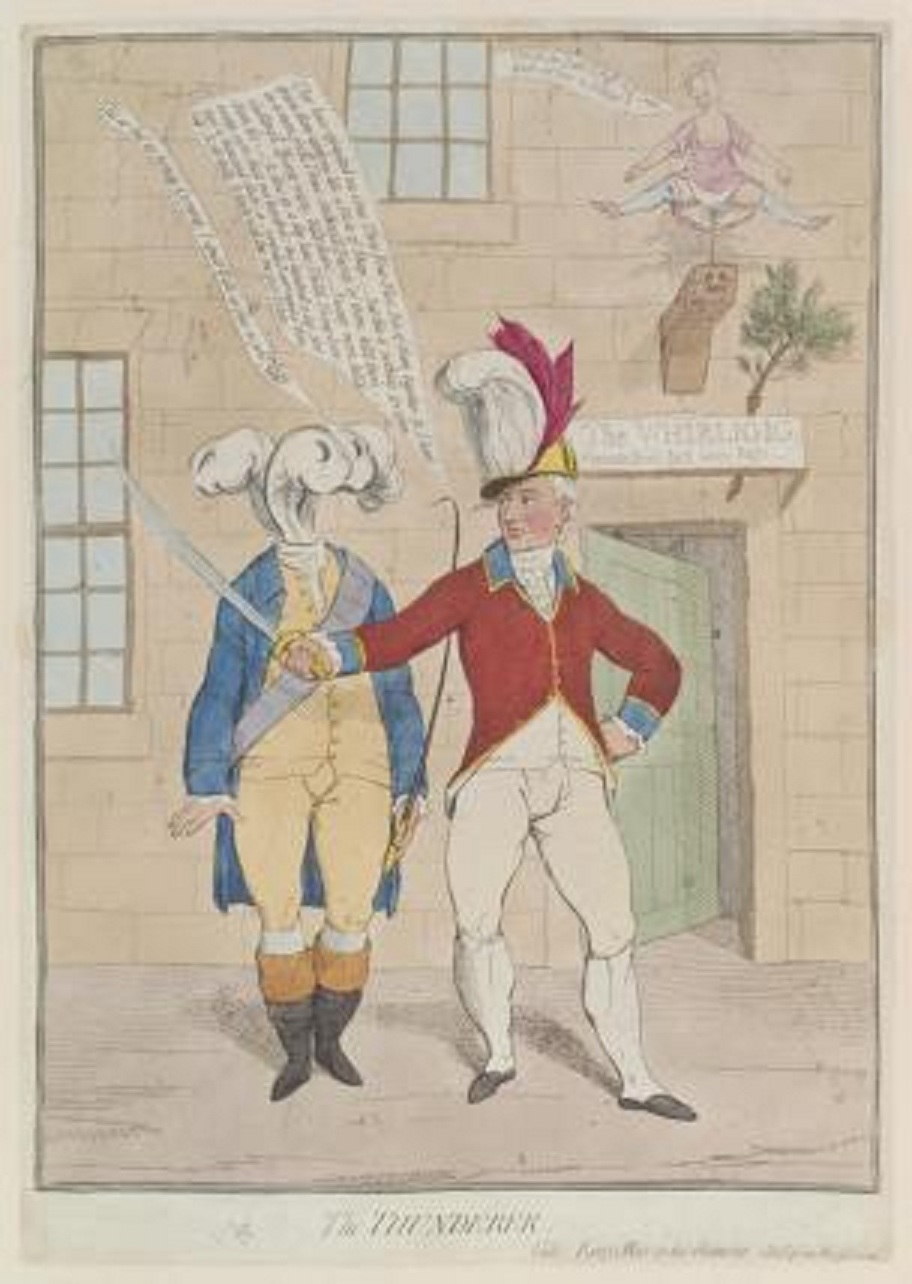
Ouch.
Tarleton would hold a seat in Parliament, where he promoted commerce and defended the slave trade against abolitionists. He would be promoted to general in 1812, but never held a combat command again, even as Britain was embroiled into the Napoleonic Wars. Eventually, Ban and Mary parted ways, and he married a woman named Susan Pricilla Bertie. They had a 35-year, childless, marriage.
He wrote a self-aggrandizing memoir titled A History of the Campaigns of 1780 and 1781 in the Southern Provinces of North America.
Blogger Susan Ardelie calls Tarleton “the original Byronic hero before the actual Byron existed,” which is spot-on. Mad, bad, and dangerous to know, Tarleton was in some ways an avatar of his age, irresistible to the ladies, and a terror to his enemies. Except to the salty Frontier Partisan Daniel Morgan. The Old Waggoner could raise some hell of his own — in rougher company than Tarleton’s society set — and he handed Tarleton his own ass.
That’s pretty satisfying to a Frontier Partisan…

Matthew Ilseman says
Tarleton does seem like he could have been sociopathic. Extreme pleasure seeking is a trait common among sociopaths (and narcissists.) Of course, the only way to know would be to send a psychologist back in time to do extensive interviews with him.
Quixotic Mainer says
It seems to me that most of the descriptors and accusations, both fair and unfair, that were aimed at Tarleton were flung at Custer after him, and Rupert before. There’s a dark triad pony soldier archetype to be found there somewhere. And maybe a book for someone who made better use of their history degree than I!
JimC says
Maybe there’s genetic memory/programming to hate and fear hard-hearted raiders on horseback. Mongols and such… This kinda thing ends up being mulled over at 3 a.m. you know…
deuce says
Say what you will about Tarleton, but he wasn’t a coward. He reminds me somewhat of the Marquis de Morès.
Mary Robinson looks to’ve been one tasty crumpet.
JimC says
That is a valid comparison.
The Black Tyrone says
Nice post Jim… We forget after the fog of war and the need for “history” that the definition of American was not set in stone. When one objectively in retrospect considers the “times”, The American Revolution was actually a civil war. Civil Wars are most savage. One might view them through history as such.How else can one pour grapeshot into the ranks of those that once were brothers less than 100 years later? . Aside.. Tarleton and Arnold were the great “bugaboos” of the war for us and to a lesser extent depending on one’s place of settlement and interest, Simon Girty. I, the more I read and reflect think Benedict Arnold needs objective reassessment.
JimC says
There’s a film on Arnold that does a good job of depicting how ill-used the man believed himself to be — with some justification. The 18th Century military did poorly by a number of men, including George Rogers Clark.
You can track Benedict Arnold: A Hero Betrayed down on YouTube now, I think. Worth the time.
https://frontierpartisans.com/a-hero-betrayed/
The Black Tyrone says
Thanks Jim, In the colonies; 1/3 loyalists 1/3 Patriot 1/3 neutral. Arnold deserves another look . Arnold’s record in New York State was worthy of greater credit and his March to Canada through the New York wilderness bordered on “Homeric”. He also took counsel in his wife as most husbands do. A fault?? I am not an Arnold apologist but really…
The Black Tyrone says
Another late thought, arguably the most beloved American general and a true gentleman, Robert E Lee was eventually forgiven. (except by those with little historical perspective and understanding) History has it, he never referred to federal troops as the enemy but rather as “those people”.
Alex Whitfield says
Interesting that Brant gets the “monster” label while Tarleton’s butchery at Waxhaws — where his men refused quarter — is framed as mere hardness. The contrast between reputation and reality cuts both ways, and Tarleton’s own legend was built on very real atrocities.
JimC says
The “Monster Brant” label is grossly unfair to the man — and certainly reflects to some degree the racial antipathy of the time and place. Though Walter Butler, the son of the commander of Butler’s Rangers, was also regarded as a kind of criminal — both being sullied by the Cherry Valley Massacre, where Butler lost control of his command, and Brant failed in his effort at constraint.